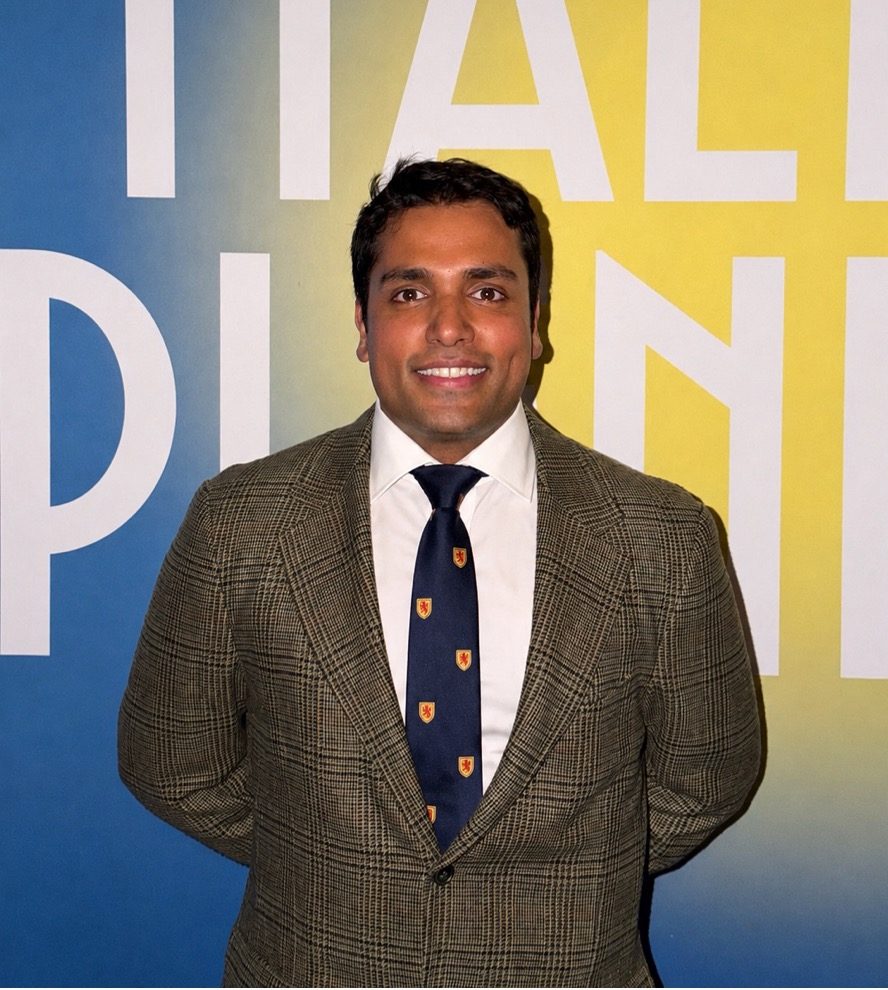
In this reflection, Raman Solanki shares how his time at the Harvard Graduate School of Education (HGSE) helped him connect experiences across military service, public leadership, law, advocacy, and the arts into a deeper understanding of education’s role in society. Raman reflects on how HGSE provided the language and framework to transform personal loss, service, and leadership into meaningful impact. He explores the intersections of education, law, public policy, and cultural preservation, highlighting experiences with the Empowerment and Impact Fellowship, Harvard Law School’s Animal Law and Policy Clinic, student leadership, and the founding of Cambridge Collective.
Raman Solanki

Before coming to the Harvard Graduate School of Education, I had lived through several very different worlds. I enlisted in the U.S. Army as an 88N, a role that taught me how much careful planning, coordination, and responsibility go into every mission. I had also worked in public service, built connections across art and cultural institutions, and spent years navigating systems that often felt too large and complicated for ordinary people to move through alone.
I had also experienced deep personal loss. My mother passed away after a long battle with cancer, and my elder sister died from complications related to Multiple Sclerosis in her late twenties. Those losses changed the way I understood responsibility, care, institutions, and the quiet burdens people carry into every room.
By the time I applied to HGSE, I was not looking for graduate school simply as another credential. I was looking for a place that could help me make sense of the different parts of my life and give me the tools to turn that experience into service.
Education, to me, has never been only about classrooms. Some of the most important learnings in my life happened outside traditional academic spaces: in the U.S. Army, where leadership is tested under pressure; in caregiving, where responsibility becomes daily and real; in public systems, where bureaucracy can shape the course of a life; and in cultural institutions, where art and history shape whose stories are preserved.
HGSE gave me a language for many things I had experienced but had not yet fully named. The Empowerment and Impact Fellowship, led by Houman Harouni and Joe Pinto, was monumental in helping shape that language.

I chose HGSE because I wanted a place where education was understood broadly enough to include families, universities, nonprofits, museums, governments, legal systems, and communities. That breadth is what drew me in.
Much of my work before HGSE had been shaped by service. In the U.S. Army, I learned the value of discipline, preparation, and showing up even when things are difficult. I learned that leadership often means doing the work that may not be visible but still makes everyone else’s success possible. I also learned that people come from very different backgrounds, and that a shared mission can bring them together in powerful ways.
That connection between military service and graduate study was reflected in an HGSE Magazine profile, Army Student on a Mission.

One of the most meaningful parts of my year was joining the Animal Law and Policy Clinic at Harvard Law School, serving as an advanced student clinician. Through the clinic, I worked on issues connected to access, law, community, and public education. Our team worked with Jain families in Massachusetts to better understand the need for plant-based meal options for Jain K-12 students in public schools. That experience reminded me that policy is most powerful when it begins by listening. It also showed me how education, law, religion, family life, and public institutions can all intersect in the daily experience of a student in the school’s cafeteria

HGSE also gave me opportunities to lead and create spaces for conversation. As part of student leadership, I helped organize and moderate programs that brought people together across disciplines. One of those moments was helping bring former U.S. Supreme Court Justice Stephen Breyer to campus through the HGSE Student Law Society, of which I was the elected co-president alongside Laura Liptrap.

Another was a United Nations-inspired policy atelier at HGSE, where I moderated a panel on careers in international education and development.

Those experiences showed me that student leadership is not only about putting events on a calendar. It is about creating spaces where people can think together, ask better questions, and imagine different futures.
My work in art and culture has also shaped how I think about education. Through founding Cambridge Collective LLC, I became interested in how art moves through private and public spaces and how cultural legacy is protected. At first, that work may seem far from education. I do not see it that way. Museums, collections, universities, and cultural institutions are all educational spaces. They shape memory. They shape taste. They shape what we believe is worth preserving. HGSE helped me connect those worlds, especially in Professor Elgin’s EDU S121 course, But Is It Art?
After HGSE, I hope to continue working at the intersection of public service, art and culture, and law. I am interested in systems that help people access opportunity, whether through schools, legal advocacy, public institutions, or cultural spaces that preserve and share knowledge.
I have lived in Harvard Square since 2016, arriving when Drew Gilpin Faust was president and remaining through the presidencies of Larry Bacow, Claudine Gay, and now Alan Garber. Over those years, Harvard has never felt like a distant institution to me. Its changes have shaped the streets, conversations, rhythms, and ambitions of Cambridge itself. Living here taught me that universities are not only places of study. They are civic institutions, cultural anchors, and communities whose decisions ripple far beyond their gates.
HGSE is not just a place to prepare for the next step. It is a place to pause long enough to understand why that next step matters. I came to HGSE because I believed education could help people move forward.
I will leave HGSE believing that even more strongly.