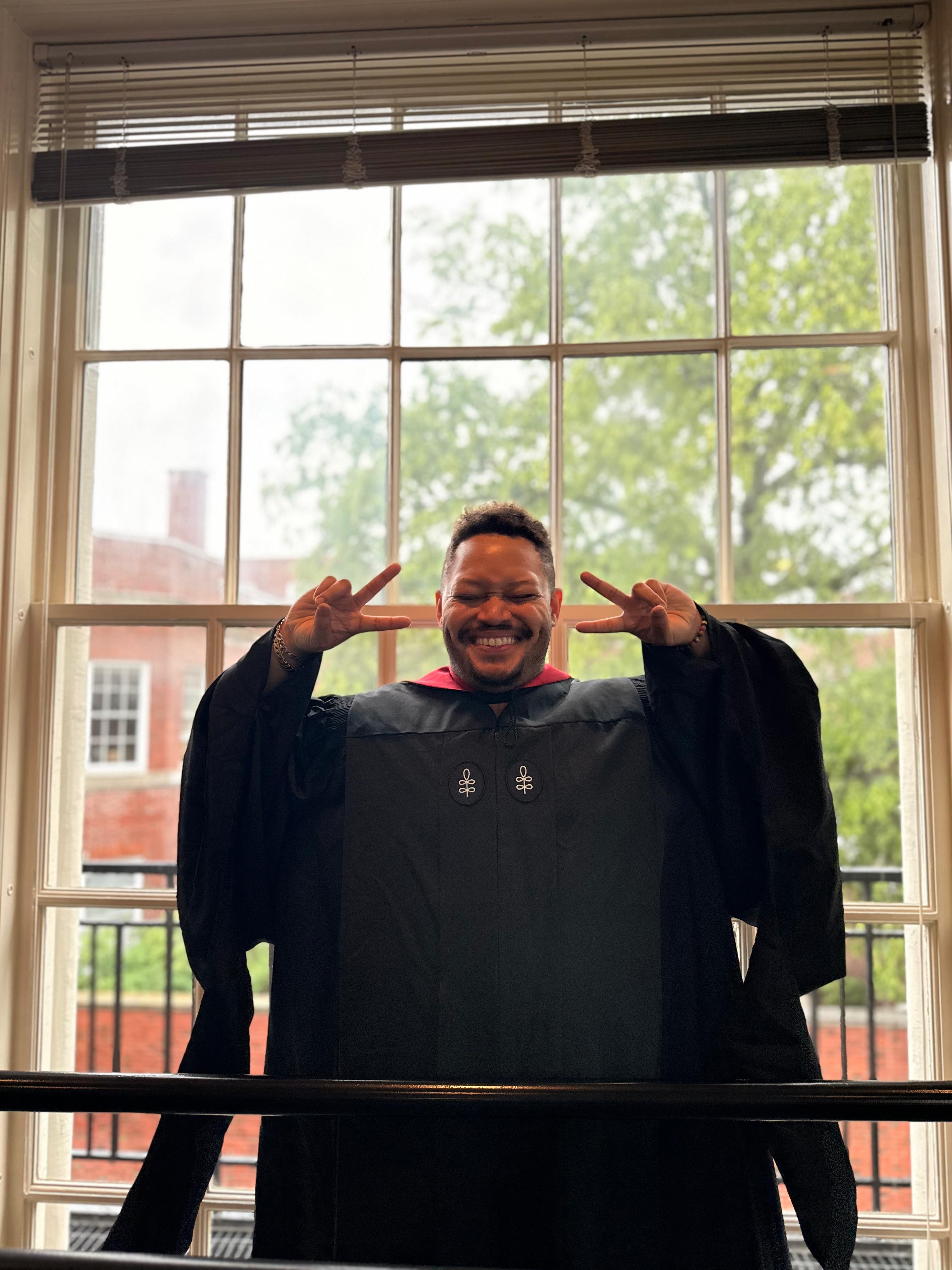
In this reflection, Ryan Robinson shares how his time at the Harvard Graduate School of Education (HGSE) helped him bridge his passions for science, entrepreneurship, education, and community impact. Drawing on experiences as a quantum physicist, educator, and founder of SENSA, Ryan explores how HGSE reshaped his understanding of leadership, workplace culture, and lifelong learning. He reflects on developing “The Human Protocol,” a human-centered approach to scientific innovation that prioritizes psychological safety, purpose, and personal growth, and argues that education extends far beyond the classroom into every aspect of life and work.
Ryan Robinson (he/him)

Why I Chose HGSE
Funny enough, my mom was actually the one who told me to apply to HGSE! At the time, I had been teaching in low-income areas across the Greater Boston area, including Dorchester, Roxbury, and Lynn, and giving back what I had learned at MIT as an undergrad. I was excited to go to HGSE because I wanted to be around other teachers who were as passionate about helping people as I am. Not only that, but I also wanted to improve my skills as both an educator and an entrepreneur.
I also own a company named SENSA that helps people find out how inflamed they are by simply spitting into a bottle. Using my background as a quantum physicist, I had created my own major at MIT called “Quantum Engineering,” which looks at broad applications of quantum physics — even beyond quantum computing. For example, did you know plants “use” quantum physics to make photosynthesis work? This is especially astounding because it happens at room temperature, and for a long time, many quantum physicists and quantum computer scientists thought quantum effects had to happen in cold temperatures near absolute zero or in very isolated spaces to avoid disturbing the very sensitive “quantum-ness” of the system.

Before COVID, I was applying quantum physics to help make medications safer and more affordable for people. That work eventually led to my involvement with the White House during COVID, where I worked with a good pal of mine, Logan Thrasher Collins, to help find treatments for COVID and future coronaviruses. During COVID, my company also hosted free virtual “info sessions” to combat misinformation about everything COVID-related.
During COVID, I had two major takeaways. First, education is important to protecting marginalized communities. Just like my mom says, “knowledge is power.” Second, I realized that people with pre-existing inflammation had a much harder time with COVID. I soon saw that practically everyone is dealing with inflammation issues, even if they do not know it, and that inflammation is compromising our public health and the quality of our lives.
Naturally, afterward, I was looking for ways to give back to the community both by teaching and by designing new technology to help people live healthier lives and put their health back into their own hands.

What I Plan to Do After HGSE
I plan on incorporating what I learned at HGSE into my company, SENSA, to make it a psychologically safe workplace that feels more like a community. I will use what I learned to be a better boss, decenter myself like I learned in my classes, and help my team members feel both safe and empowered. I am going to foster a mindset and culture of lifelong learning, impact, and personal development in the company, and teach my managers how to self-analyze, question their assumptions, own their impact, and always put our team members’ humanity at the forefront of what we do.

For example, one thing I will develop specifically is called The Human Protocol.
Normally, labs run in a very matter-of-fact fashion. Do this. Do that. But the lab rarely considers the scientists themselves. What motivates them? How are they feeling today?
I incorporated what I learned at HGSE, including Daniel Wilson’s class “Learning in Teams” and Universal Design for Learning, to first motivate scientists. Why are we doing this work today? Who are we helping? How does this help them?
For example, when scientists come into the lab, we have them do a mindfulness “reset,” where people can spend some time doing a mindful activity of their choice, such as yoga, meditation, journaling, or something else that helps them center themselves. Then we ask how people are feeling and what their energy level is right now. Maybe we do not want someone doing extensive scientific experiments if they just had a hard breakup or they are in the middle of a move.
Moreover, our work helps people with inflammation. Our work especially helps women, who often deal with more inflammation than men due to a myriad of factors ranging from stress, to biology, to systemic bias against them. I will show — and not just tell — the team videos of people explaining how tough it is to live with inflammation.
Then, during the work itself, we will use AI as a lab partner to help jot down notes and find relevant research studies to explain any surprises we may find while experimenting. During breaks, we check in with each other and do bonding activities to feel closer as a team, from little games to simply eating together. Finally, at the end, we look back at what happened and tie the results of that day’s work to our larger mission, sometimes called our “theory of change.” How did your work today help people tomorrow?
Naturally, sometimes we do not get the results we wanted, which can feel disappointing. But we have a motto I actually learned from an intern at the company, Nathan. He says, “There’s no such thing as a failed experiment.” I turned that into our lab’s motto. So even when we get mixed results, we look at what we learned, how we improved the customer experience, and how we helped communities in the long term. Because again, there is no such thing as a failed experiment.

Companies in the past may not have done anything like this because we are so used to a Taylorist perspective on work, where everything is about production and humans tend to be seen as machines. But if AI teaches us anything, it is that humans are not machines and have never been machines. In contrast to AI, we can see just how human we really are.
So while, if you ask someone what a job usually entails, they will not always say “fun” or “engaging.” But why can’t it be?
The Human Protocol, which I developed from our studies at HGSE, does just that. The Human Protocol, which I have already started to implement with my team, has been great at keeping people engaged during long lab sessions where focus and energy are crucial. It also helps make onboarding new talent more engaging, attracts top talent, and helps people walk away feeling engaged, motivated, and inspired. It makes the lab a safer, more productive, and more enjoyable place to work.
This Human Protocol helps scientists feel a bit more… human. And that is better for everyone.
See, while AI is a powerful tool, it has very clear limitations when it comes to generating new knowledge. In the lab, AI is figuring it out just as we are, and we have proven AI wrong many, many times. Moreover, AI still needs reliable data to provide accurate answers. Therefore, we need humans to operate at their best in order to leverage the unique skills humans bring to the table when working in conversation with AI.
Judgment. Real-time execution. Values. And deciding what is important.
We see learning not just as a process, but as a mindset. Many people see education as something that happens exclusively in the classroom, but the truth is that education is everywhere: in the classroom, in the lab, in the workplace, at the dinner table, and even in the boardroom.
Not to sound corny, but life is the ultimate teacher, and class is always in session.
