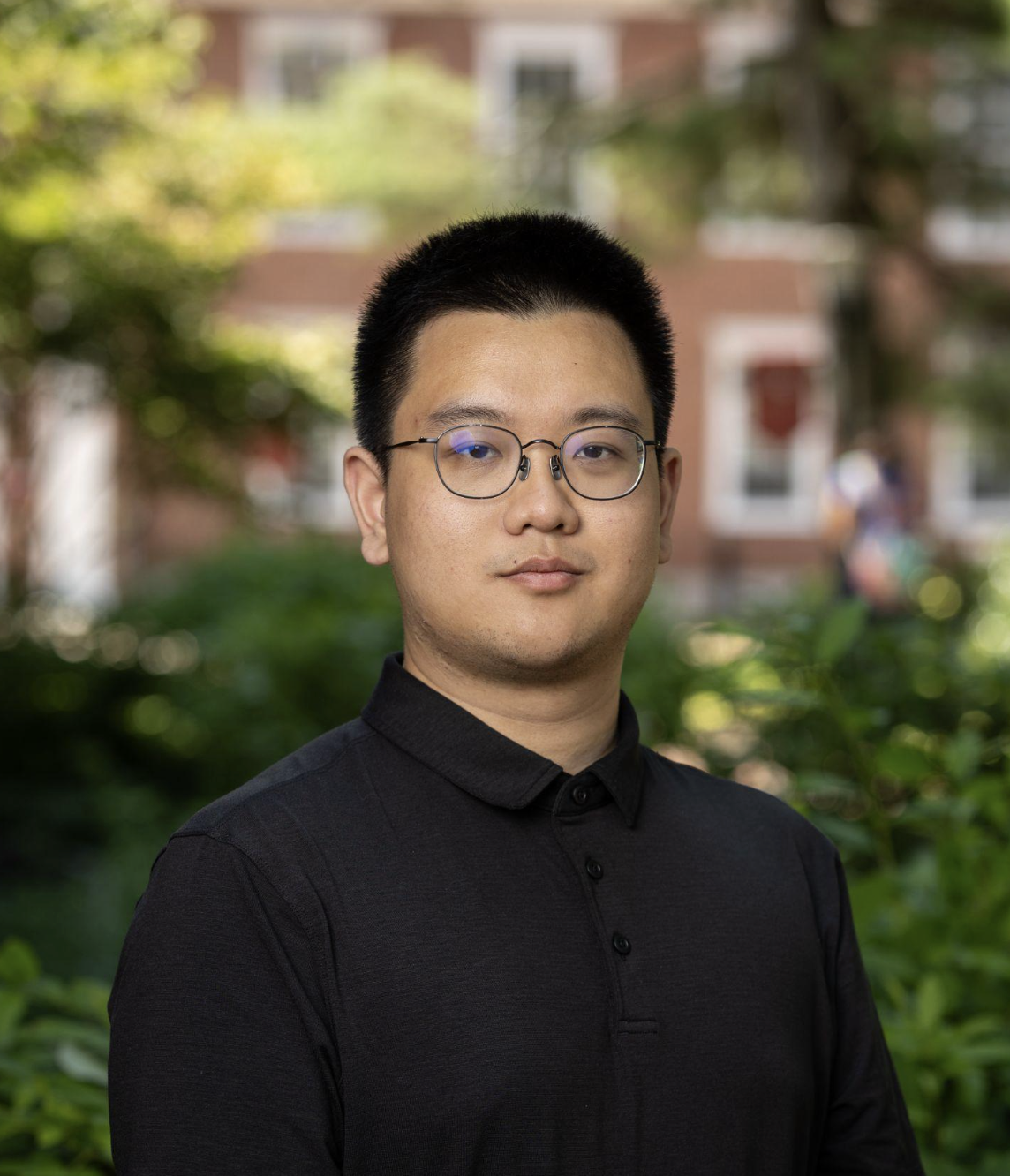
This is the second of four profiles on students in our Teaching and Teacher Leadership Program: Licensure Strand. Students in this strand will pursue Massachusetts initial licensure in secondary education with Sheltered English Immersion (SEI) endorsement. To learn more about our two licensure pathways, internship and residency, please visit our website.
Last December, I graduated from UCI with a degree in mathematics. After deciding that I wanted to become a teacher, I quickly realized that what I lacked most was classroom experience. That was one of the main reasons I applied to TTL. For me, the best way to understand teaching was to walk into a school, work alongside students, and learn through practice.
But that was not the only reason I chose TTL.
At seven o’clock this morning, I was once again hurrying through a crowded subway station. Because of an unexpected phone call on the way, I arrived at North Station three minutes later than usual, worried that I might miss the commuter rail to my placement school. Fortunately, as on many mornings before, I made it onto the train with only a few minutes to spare before it departed.
As I sat down, it suddenly occurred to me that this scene felt a little like the past year of my life. Like so many people rushing through North Station in the early morning, I was tired, a little anxious, and still moving forward, trying to make it in those final moments before time ran out—and somehow, at the last moment, finding my way back onto the right track.
The train ride between catching that train and arriving at the next destination of my day—my placement school—is one of the rare stretches of time that belongs entirely to me. Watching the scenery disappear behind the train, I often find myself thinking about the journey I took before arriving here.
Whenever I meet someone new, they often ask, “Where are you from?” or “Where is home?” I never quite know how to answer.
It seems that I have always been on the road. I spent elementary school in Beijing, middle school in Shanghai, high school on Long Island, and college in Irvine, California. At twenty-three, I have spent only about five years in each place. Now I am in Boston.
Until high school, I often felt as though I were walking through a fog. I knew I had to keep moving, but I did not know where I was going or who I would eventually walk that road with.
A journey without direction is little different from wandering. And wandering without companionship can begin to feel a lot like exile.
Whenever I entered a new environment, I was eager to adapt but afraid of becoming too attached because I feared having to leave.
The first person who changed that was my high school calculus teacher. Her care and encouragement changed me before I even realized it. When I graduated, she told me that if her encouragement had meant something to me, I could carry it to college and pass it on to others.
And so, somewhere in the fog, I was given a torch.
At UCI, I first tried to pass that torch forward through Math CEO, a mathematics education and community outreach program that primarily supports Latino middle and high school students.
At first, I joined because I was good at math and hoped to make friends. But gradually, what stayed with me was not whether I had explained every problem perfectly. It was watching a student become more confident.
Seeing someone move from “I can’t do this” to “Maybe I can try” began to matter more to me than the answer itself.
I also realized that I was not the only person on the road. Around me were classmates, professors, teachers, and mentors who had received something from others and were now passing it forward. In different ways, we were all carrying torches.
That realization led me to decide that I wanted to become a teacher. If I had to give the torch in my hands a name, I would call it encouragement.


I first began to understand what it meant to carry that torch as a teacher during the CHSA summer program before I came to HGSE. There, my teaching team taught a Mathematics Preview Program. Some students hoped to skip Precalculus and move directly into AP-level coursework, so we covered topics such as trigonometry, limits, and rational functions in a short period of time.
At first, I worried that the material might be too difficult and whether the students were really following.
Then one morning, I learned how some of my students were getting to school. It was summer vacation, yet they woke up early, took a commuter train, and arrived before eight o’clock to spend much of the day studying mathematics.
That changed the way I saw them. They were not simply students waiting for me to teach them something. Before they entered the classroom, they had already made their own choice. They had their own goals, worries, strengths, and reasons for continuing forward.
Some needed more encouragement; others needed more challenge. But the next morning, they would show up again.
I slowly began to understand that teaching is not simply about standing at the front of a classroom and pointing out a road for students to follow. Many times, students are already on the road.
A teacher’s role is to see where they are, walk alongside them for part of that journey, and, if possible, leave them with a little more light before saying goodbye.
By the end of that summer, I was even more certain that I wanted to become a teacher. Although I had to part ways with my mentor and students, I still carry with me my students’ messages and signatures, my mentor’s lessons, and the letter I received at the end.
I will carry that torch forward and continue passing it on. At the same time, I began to understand more clearly why I am still on the road.
And it was this realization that ultimately brought me to TTL, where I can continue walking alongside educators who share the same commitment.
Albert Chenxie is an Ed.M. candidate in Teaching and Teacher Leadership at the Harvard Graduate School of Education, pursuing Massachusetts initial licensure in mathematics for grades 5–12. He earned his B.S. in Mathematics from the University of California, Irvine. His experience includes more than 500 hours of direct instruction and over 1,000 hours of teaching, tutoring, mentoring, and educational support across secondary, undergraduate, multilingual, and accessibility-focused settings.
Leave a Reply