Teaching and Teacher Leadership Program will prepare novice and experienced teachers with the skills, knowledge, support, and professional network to design and lead transformative learning experiences, advance equity and social justice, and generate the best outcomes for students in U.S. schools.
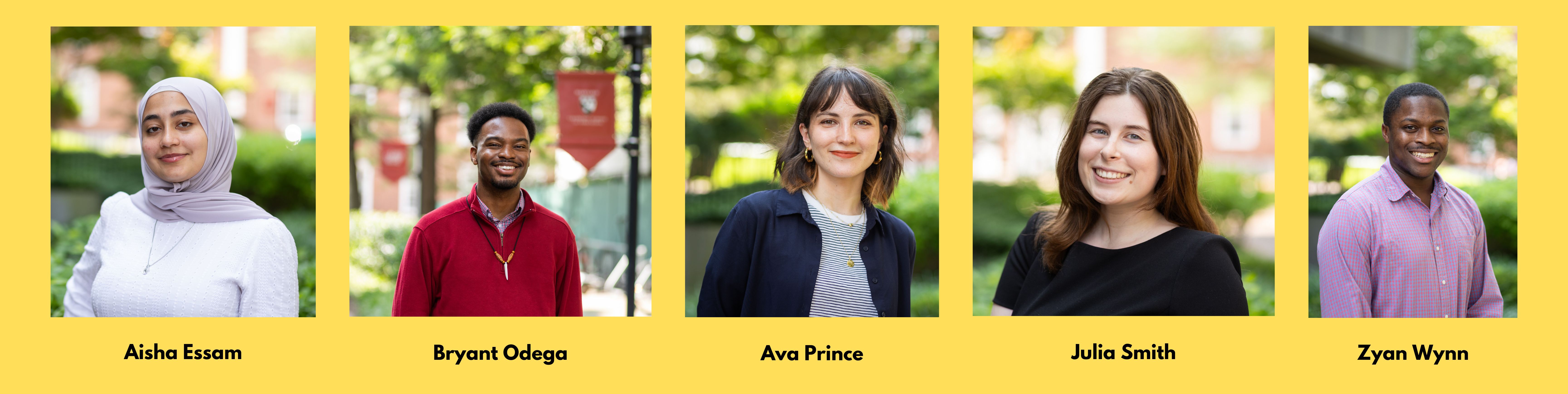
We asked five of our current TTL students about their decision to apply to TTL and their experience with the program and HGSE so far. Meet Aisha Essam, Bryant Odega, Ava Prince, Julia Smith, and Zyan Wynn from the TTL Class of 2024!
What led you to apply to the Teaching and Teacher Leadership program?
Zyan:
During undergrad, I minored in Teacher preparation, so I spent the last four years falling in love with education and teaching. When I was looking for graduate programs, I wanted a program that would allow me to continue learning and growing as a teacher, but I also wanted a program that allowed me to get relevant and full field experience. Teaching and Teacher Leadership allowed me to learn both inside and outside the classroom through being a classroom instructor and still attending graduate classes. It gave me the best of both worlds: the opportunity to both learn and practice.
Ava:
I have been working in education since I graduated with a history degree from Oberlin College
around five years ago. I felt that the Teaching and Teacher Leadership program was well aligned with my passion for the study of history as a conduit for combating social and historic inequity and advocating for justice. I had worked in the museum space for several years, and abroad in Tokyo teaching ESL, but I wanted to become a history teacher for students in the communities I care for. I wanted a program which allows me to translate my love of history and of the process of doing history in a way which emboldens young people with the skills necessary to advocate for change. I also knew that Harvard was home to one of the country’s most excellent academic art museums, and was excited for the
opportunities to continue pursuing museum education and arts integration into my studies.
Bryant:
What led me to apply to the Teaching and Teacher Leadership program at HGSE was the opportunity to connect with educators passionate about disrupting oppressive systems within education and creating equitable spaces that uplift all learners. Additionally, having access to leaders in the academic field working on education issues, such as Professor Givens’ work on the history of Black education and Professor Villarreal’s work on Ethnic Studies and Education, was major motivators for me to join the program.
Aisha:
I applied to the TTL program because I had been interested in the Harvard Teaching Fellows program since I was a first-year at the College. What convinced me that TTL was for me was talking to current TTL students—they shared that they were learning so much through the program and it felt like they were making a real impact on students. Something else was the fact that it was their first year teaching, which would be difficult anywhere, but the program and the reflection on their teaching provided them with support and a space to build on the teaching skills and passion they already had.
Julia:
I applied to the TTL program because I knew I was interested in getting a master’s degree in education. My long-term career goal is to spend as much time leading a classroom as possible, and I was very interested in one of the concentrations offered at HGSE. Unfortunately, as I am in the Teaching Track of TTL I cannot declare a concentration, however, there are opportunities to take some of the classes within the concentration.
Can you describe a memorable classroom experience or project that impacted your learning thus far?
Zyan:
One of the most memorable classroom experiences was the “Why are you here?” activity we did in our Fieldwork class for Teaching Residents. The exercise encouraged us to dive deeper into our “why” or reasoning for being herein this school, field, and calling. With the hectic graduate school schedule and part-time teaching, it can be easy to forget the reason behind this choice. This activity gave me the breadth and chance to remind myself of that and to hear the experiences of my classmates as well.
Ava:
I leap at any opportunity for interdisciplinary learning. As an extension of my work with my college’s art museum, I paired up with a local poetry residency program and led a lesson in the classroom on how poets interact with works of art in different ways. I then brought the students to the art museum, and students wrote poetry in response to works on view. Working with students to bring out their own voice and reflections based on the lesson I’d written was empowering for me and really brought to light the multitude of opportunities available for integrating the arts and cultural institutions into the classroom.
Aisha:
There are a few students with whom I struggle to keep motivated and on-task. For the first few weeks, I tried various approaches, to no avail. One day, my fellow TTL student asked one of the students to sit with her, and this individualized attention gave her the opportunity to walk him through the work. Inspired, I used this same tactic in my following class with another student. Sitting with him, I learned more about how much he was learning and retaining and how I could motivate him to be consistent as much as possible. This completely transformed my approach to students and how I structure my lessons to make sure I can provide individual support when possible.
Julia:
At the end of my CHSA experience, one of my students told me that I was too nice when giving feedback and that I needed to make my feedback harsher, so they knew what needed to be fixed. Part of the criticism came from the truth, I was being nice in my feedback, and I did not want to tear the students down after they put in a lot of effort. However, I now am more conscious of how my feedback can come across as overly complimentary without providing the constructive criticism they need to improve. I had never been called out on my kindness before, but it ended up being the exact thing I needed to improve as an important teaching skill.
How have you been involved in the broader Harvard and HGSE communities?
Zyan:
Dance has always been one of my biggest moments of relaxation and passion. A couple of weeks ago, I was able to join the Harvard Expressions dance group, which is a hip-hop dance group. The experience has been thrilling and exciting. I have also been involved and attended HGSE Black Student Union events. This community has been more empowering and enlightening as I grow in my knowledge of the diversity and intellect in Harvard’s Black graduate population.
Ava:
I’ve been extremely fortunate to take part in the Harvard Art Museum’s Graduate Student Teaching Program. This program partners with Cambridge Rindge and Latin, the city’s only public high school, which is located just across the street with the museum. I am currently paired with two to three high school classes a semester, and am developing lesson plans which engage with, expand upon, or complexify students’ understanding of their in-class material. There’s also a big focus on building museum literacy and museum-going identity among young people, and to breaking down historic boundaries between museums as elite, exclusionary spaces and the general public.
Have you joined any student organizations or clubs?
Ava:
I’m a committee rep for QueerEd on campus, which supports the study of gender and sexuality and promotes awareness of the intersections of sexuality and gender with race, class, ethnicity, immigrant status, ability level, and education.
Aisha:
I have not joined any officially, but I am helping found Harvard Educators Against Gun Violence with other members of the TTL cohort. To be honest, I have taken a step back because of my schedule with teaching, but I look forward to doing more work once I solidify my footing.
What advice would you give to prospective students who are considering HGSE?
Zyan:
My biggest advice would be to think about why this field interests you. I challenge you to think about the domain you are entering, the calling you accept, and the journey you embark on. HGSE is a beautiful collection of passions, interests, backgrounds, and experiences. There is so much to learn and experience, but the one shared thing between everyone is that there is a purpose. There is a reason that they are here. That purpose is what your application and story should show. Take time to think seriously about your own why and dive into it. You don’t have to have every aspect figured out, but you need to know why and for whom you are doing this work.
Ava:
You should absolutely look for courses and clubs outside of your program! Also, be prepared for things to change and keep your mind open to new opportunities should they arise!
So far, in what ways has your HGSE experience prepared you for your future career or goals?
Zayn:
The Teaching and Teacher Leadership program provides ample classroom experience and licensure in the subject of history upon graduation, which has expanded my career opportunities substantially. I feel supported, as well, through additional coursework with the arts and learning concentration and my position with the Harvard Art Museums.
Aisha:
This is not so much advice as much as it is insight but know that you are joining an incredibly warm and supportive community. Particularly among TTL, I’ve found people from whom I can learn so much, and I’ve found life-long friends. Teaching is hard anytime and anywhere, but having my cohort from HGSE is making it much easier to make it through the year.
Julia:
When I applied to HGSE, I applied out of pure desire with no expectations of actually being accepted. All I thought was “I really want this and if I don’t apply now, I’ll always question ‘what if.’” When I was accepted, I was in disbelief. I spent weeks thinking that at any moment I’d get an email rescinding the offer, an email saying admissions made a mistake. I spent so much time worrying about my faults instead of celebrating my assets. That is why, if I had to give one piece of advice to prospective students, I would say stop asking yourself “Am I worthy of this opportunity,” or “Do I deserve this opportunity,” and instead ask “Do I want this?” and go from there.
So far, in what ways has your HGSE experience prepared you for your future career or goals?
Zyan:
On a practical level, HGSE has given me many opportunities to get real-time and field experience from my job to the summer residency to learning from the ideas and examples of my classmates. It has allowed me to learn from my instructors and experience my peers’ and aspiring teachers’ ideas and thoughts – their ideas are beautiful and inspiring. On a grander scale, the HGSE experience has allowed me to explore the stories of many people. We are entering a field that calls for us to lead with acceptance and be driven by learning and listening. HGSE has given me the chance to sharpen and grow in this. I have been surrounded by so many different and inspiring personalities and stories. I have learned so much and had the chance to network and build unimaginable connections essential to this field that we are entering.
Bryant:
As a future Ethnic Studies High School teacher, HGSE has provided me the opportunity to student teach at a Boston public school currently piloting Ethnic Studies while also taking a graduate course on Ethnic Studies in Education taught by Dr. Villarreal. My experience is preparing me for my future career goals by providing a space where I can engage in the intellectual, academic work while also putting my learning into practice both at HGSE and my school site.
Aisha:
HGSE, particularly the TTL program, has given me a real experience in teaching and reflecting on that teaching. I have been honored with the opportunity to be the teacher of record for 47 seventh graders. Though the first year has been difficult, I feel like I am learning a lot and having a real impact on students being their lead teacher for the year. This has given me a much better idea of what kind of teacher I want to be throughout the year and in the future. I am also considering education generally, particularly in advocating for educational equity, and this program has given me field experience in what kind of strengths schools have and what can be priorities in pursuing educational equity.
Julia:
Being that my current goal is to spend as much as a classroom teacher as possible, I’d say that HGSE is preparing me well. Having the opportunity to practice what we are learning in our methods classes in an actual classroom through my internship has been wonderful. I have never been turned away when seeking opinions or advice from any staff at HGSE, whether we were acquainted with each other or not. Everyone there is so optimistic about the future of education and trying to make the future of education better that it instills even more passion into me than I already have. Sometimes, there can be a lot of pessimism in schools and the classroom, which can drive people away. Having a support system to fall back on can make it easier to push through challenges and fight for longevity.
 HGSE Admissions Blog