Arriving in Cambridge in August felt a little bit daunting; I’d just turned 30, was worried that I’d be too old to get along with anyone, and too far out of university to keep up with the work. I’m very happy to report that these fears were unfounded!
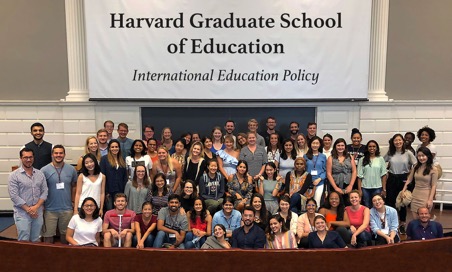
I am part of the International Education Policy (IEP) cohort here at HGSE. IEP is one of the largest groups this year with over 80 students with particularly diverse backgrounds. Some are interested in Early Childhood Education, some in Refugee Education, whilst some come with a background in Social and Emotional Learning. There is a large proportion of overseas students as you might expect given the title of the cohort, but one of the things that has been interesting to me so far has been seeing the range of challenges we’ve faced as a group. There are teachers, policymakers, program managers, and consultants. It really does help to cultivate discussion in groups when you look around and appreciate that those around you have been there and done it. My own background was working for a consultancy in the United Arab Emirates for 6 years which provided support to families, school groups, and NGOs on pretty much any question related to education. Whilst I felt comfortable working when viewing education as a business, I had less of an idea about how to practically realize meaningful change. Coming to HGSE was my way to gain the skills required for the next phase of my career and hopefully make more of an impact on a broader range of students.
The IEP program is structured to help pass on that knowledge. All students must take 5 of their 8 classes at HGSE, of which 2 must be related to International Education. We’re asked to take a research methods class (I take S-040, a fantastic statistics class led by Joe McIntyre), and ‘Microeconomics for Educators’ if we do not already have a grounding in those theories. These prerequisite courses provide an excellent foundation to help evaluate what works and what doesn’t in policy, before hopefully going on to make changes ourselves. As important as the classes are, they are only part of the value in an education here. Learning from your peers and through extracurricular activities is a big part of life here. Some groups address focuses or concerns; others are social and more fun. Whatever you are interested in, there’s always a way to meet like-minded people here at HGSE or in the wider Harvard community.
Whilst reading this, I hope that HGSE comes across as an approachable place. Harvard always seemed a distant goal when living in the U.K. or U.A.E. but coming here made me realize that I do (and should!) have something to contribute in improving education.
A message to those thinking of applying: Do it! But before you do, think about what you are passionate about in education, and how you want to change it. HGSE isn’t looking for a ‘perfect’ candidate; you wouldn’t need to come here if you were already. But they are looking for people dedicated to education and committed to improving it in some way. Think about what you want to do, and how Harvard can help you get there.
 Chris Gyngell is an Ed.M. candidate in the International Education Policy cohort. Although originally from London, Chris spent the last 6 years working in Dubai and Abu Dhabi with Carfax Education, a company providing educational support services. He spends his free time watching sports (even American sports!) and travelling whenever and wherever possible.
 HGSE Admissions Blog